Applied AI & Agentic Systems
Agent traces connected to reviewed failures, regression cases, and release decisions.
Explore ControlSurface
Applied AI Engineer
At the intersection of agentic AI, memory systems, and software built for the real world.
I’ve always been curious about how things work, what makes them fail, and how to build them better.
That curiosity drew me to AI: agents that can reason, remember, adapt, and operate in the real world. I enjoy working across research, infrastructure, and product engineering to turn ambitious ideas into reliable systems.
I care about what happens after a convincing demo: whether a system works, scales, and lasts. My approach is a short feedback loop.
Agent traces connected to reviewed failures, regression cases, and release decisions.
Explore ControlSurfacePersistent context that preserves provenance and accounts for facts changing over time.
Explore MNEMOSReliable APIs and considered interfaces built around the people using the software.
Explore Faculty recruitment portalFrom product engineering and network research to applied AI systems.
Stealth AI StartupCognitive AI & autonomous agents
Engineering cognitive AI systems, self-healing agents, and persistent memory architectures for production use.
LNMIITProduct engineering
Built a faculty recruitment portal connecting résumé parsing, Crossref and Scimago publication checks, and role-based application workflows.
TRISX TechnologiesEdTech / FinTech
Built an online examination platform, REST APIs, and authenticated workflows across EdTech and FinTech products, with attention to SEO.
LNMIITNetwork simulation
Modeled misinformation propagation with NetLogo, Barabási–Albert networks, and a multi-wave SIRS framework.
Creative Lead & Machine Learning
GDG on Campus · LNMIIT
2024–2025Technical Lead
E-Cell · LNMIIT
2023–2024Independent tools, memory infrastructure, and products shaped by real engineering problems.
Agent production engineering
Turn agent failures into reviewed regression tests.
An engineering control plane that turns agent traces into reviewed regressions and inspectable release evidence.
Design choiceAcknowledge only after a durable inbox write.
spans per second
Measured on one local WSL2 / Docker node with 10,000 synthetic spans; not a production capacity claim.
SourcePublic · Release candidate
Temporal memory infrastructure
Agents need memory that stays useful as facts change.
A self-editing memory runtime with bi-temporal validity, six retrieval signals, and token-aware context packing.
Design choiceSeparate temporal validity from retrieval relevance.
retrieval signals
Semantic, lexical, graph, time decay, cognitive, and memory tier; an architecture count, not an accuracy score.
SourcePublic · Research runtime
AI browser workspace
Keep the webpage in the conversation.
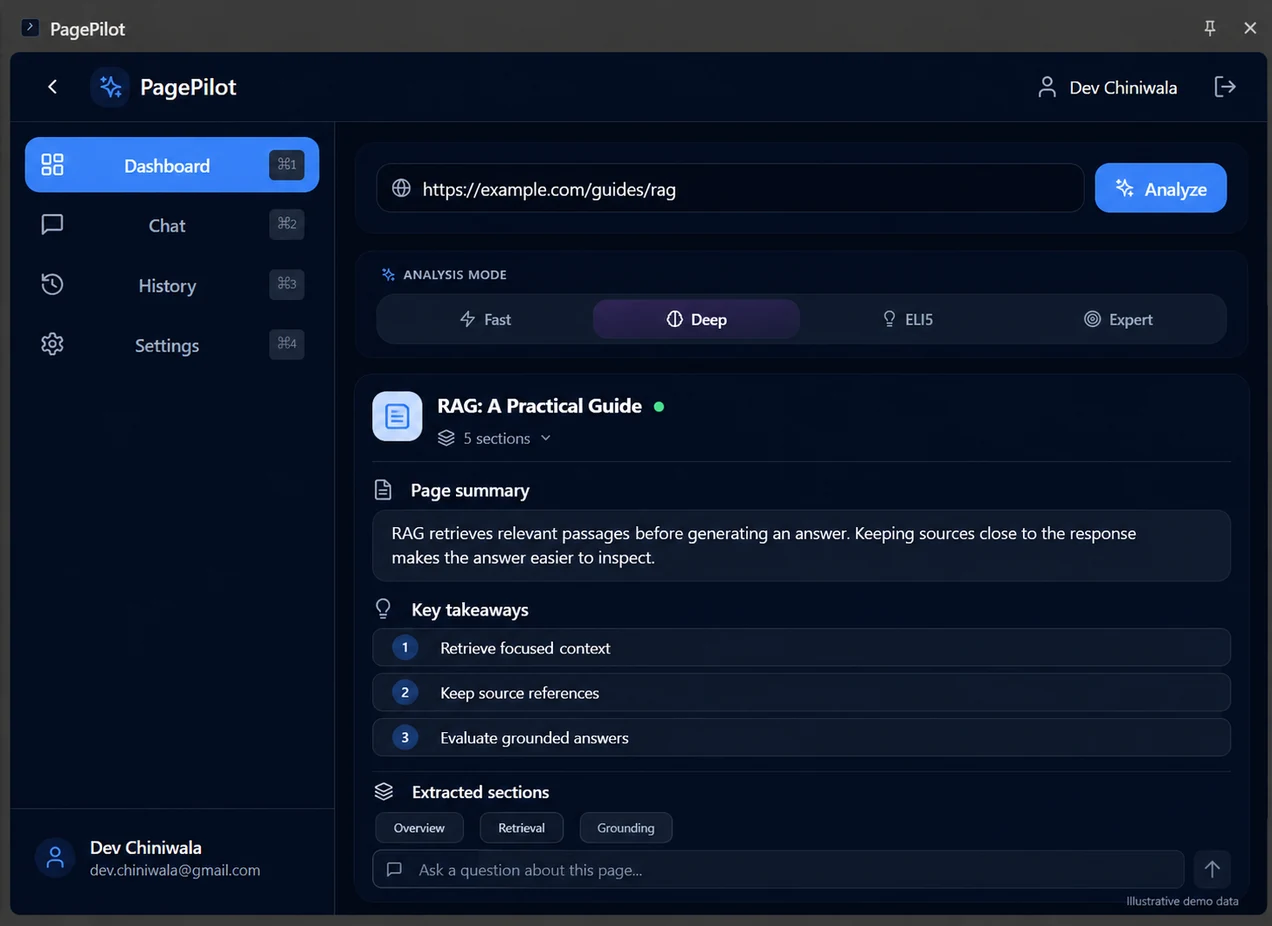
A Chrome extension for webpage summarization and grounded conversation, backed by a RAG service.
Design choiceKeep model credentials behind the backend API.
Products, tools, and ongoing explorations.
Verified intelligence systems
A local intelligence application pairing agent research with source-linked claims and a deterministic Rust verification path.
source-matching methods
SourceAgentic product search
A conversational shopping agent using semantic routing, LangGraph workflows, and distinct product and policy retrieval paths.
University product engineering
A faculty recruitment platform with résumé parsing, academic publication verification, role-based workflows, and document generation.
Persistent personal agents
A single-process personal assistant with scheduled jobs, persistent workspaces, memory consolidation, and messaging integrations.
documented MCP tools
SourceAdaptive learning intelligence
A private team project exploring personalized learning intelligence. Public implementation details remain limited ahead of launch.
Multi-agent exploration
A Python and LangGraph code project exploring agent orchestration for trading analysis.
Content workflow automation
A modular n8n workflow project connecting content generation and media services. Individual integrations require provider setup.
Fixing the details that other engineers depend on — retrieval performance, reliable SDKs, safer logs, and browser verification.
Merged pull requeststo repositories outside my GitHub account
Reticle#1286
MergedThreaded named network URLs through action verification and replay so unrelated background requests do not distort the verdict.
Aligned verdict paths and added regression coverage.
TypeScript · Browser verificationChunkHound#419
MergedReplaced whole-table chunk reads with targeted SQL and moved synchronous database work off the event loop, preserving the LanceDB fallback.
Reduced unnecessary reads; pinned behavior with contract tests.
Python · Retrieval performanceHelixDB#1164
MergedAdded signed 64-bit range validation to Python and TypeScript SDK constructors, query values, and typed parameters.
Invalid values now fail locally; boundary cases have regression tests.
Python / TypeScript · SDK reliabilityDataMind#21
MergedImproved audit error redaction to protect secrets while retaining useful debugging context.
A focused security fix at the logging boundary.
Python · SecurityGitHub snapshot · 16 Oct 2026. Count covers merged PRs authored by DevChiniwala, excluding repositories owned by that account. Each selected PR links to its merge record. View the GitHub search ↗
The tools make more sense in context. Start with the systems I've built, or explore the full working inventory.
A self-described working inventory across projects, experiments, and learning. Project examples show specific usage; inclusion does not imply equal proficiency with every tool.
The complete toolkit
Tool links open documentation
From system boundaries to product interfaces.
ControlSurface connects a Python SDK and ingestion service to a Next.js investigation interface. Its PostgreSQL inbox and ClickHouse projections make the boundary between accepted and derived data explicit.
Read the ControlSurface case studyTraining, inference, and the questions in between.
My adversarial-defense-methods repository curates research on attacks, defenses, robustness, and privacy. It is a reading collection; the notes do not imply a benchmark or a trained model.
Browse the research notes (opens in a new tab)Connect reasoning to tools and useful evidence.
HeyClara connects the Claude Agent SDK and shared MCP tools in one persistent daemon. Scheduled work, messaging channels, and durable workspaces preserve continuity between conversations.
Read the HeyClara case studyTake a capability from a process to an interface.
PagePilot pairs a React browser extension with a FastAPI retrieval backend. Model credentials stay behind the API while the extension keeps the current webpage close to the conversation.
Read the PagePilot case studyKeep context useful as facts and time change.
MNEMOS separates temporal validity from retrieval relevance. Graph associations, dense and lexical retrieval, and token-aware packing help assemble context under a bounded budget.
Read the MNEMOS case studyMake changes observable, reviewable, and repeatable.
ControlSurface connects OpenTelemetry traces to incident review, regression cases, and release gates. Source evidence stays linked to the decisions made from it.
Read the ControlSurface case studySimulation & modeling
NetLogo documentation (opens in a new tab)Integrated B.Tech + M.TechComputer Science and Engineering
Five-year integrated dual degree, alongside applied AI research, open-source engineering, and campus technical leadership.
LNMIIT · Jaipur, India2022 — 2027
Udemy
Kaggle
Kaggle
Elements of AI
Working on an ambitious AI product, agent infrastructure, or a difficult engineering problem? I’d love to hear about it.
Open to interesting collaborations